
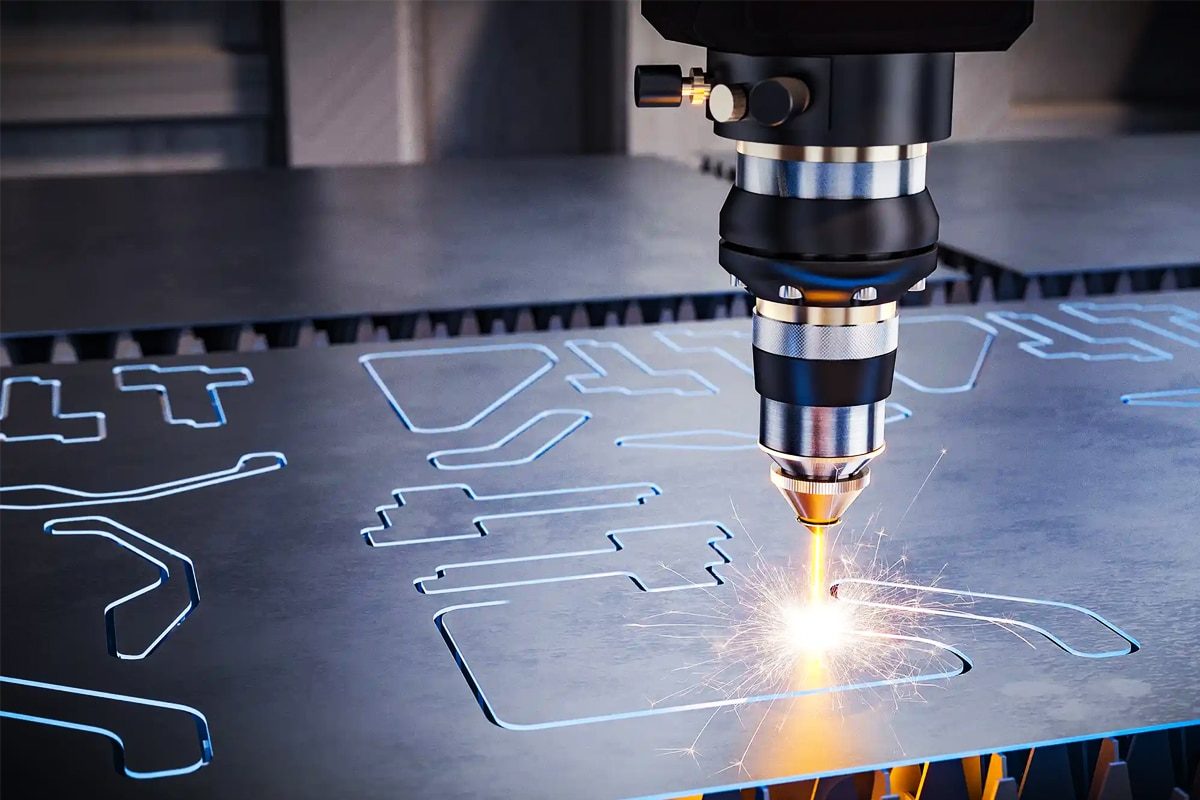
The Influence of Assist Gases on Laser Cutting
Laser cutting is widely used to produce precise components from sheet metal and other materials, but its performance depends on more than laser power and motion accuracy. The gas delivered through the cutting nozzle plays a central role in determining how efficiently material is removed and what condition the finished edge retains. Understanding assist gases is therefore essential to achieving consistent quality and controlling production costs.
In conventional metal laser cutting, a focused beam heats the workpiece, while an assist gas jet drives molten material out of the narrow cutting gap, or kerf. Depending on its composition, the gas can also support a chemical reaction that releases heat or limit contact between the hot cut edge and oxygen in the surrounding air.
Oxygen, nitrogen, and compressed air are the most common options, each offering different advantages. Oxygen supplies additional heat through oxidation and is widely used for carbon steel, although it leaves an oxidized edge. Nitrogen supports melt removal while minimizing oxidation, making it valuable when clean edges are required on stainless steel and aluminum. Compressed air can lower gas supply costs in suitable applications, but its oxygen content can cause edge oxidation. Argon is used for certain specialized applications.
Gas type alone does not determine the result. Purity, pressure, flow, and nozzle configuration must work with the material, thickness, laser power, and cutting speed. An unsuitable combination can increase dross, roughness, discoloration, or incomplete cutting. Gas consumption and supply arrangements also influence operating expenses, while edge condition affects the need for cleaning and other downstream work.
This article examines how assist gases influence cutting mechanisms, edge quality, productivity, and overall cost. It explains the main gas options and the factors involved in matching gas selection and delivery conditions to specific materials and production requirements.
Table of Contents
Understanding the Role of Assist Gases
Assist gases help control how material leaves the cutting zone and how the newly formed edges interact with their surroundings. Their influence extends beyond blowing material away: gas composition and delivery conditions affect cutting speed, oxidation, surface finish, and process stability. Understanding these functions helps explain why the same laser can produce different results when the gas type, purity, pressure, or flow changes.
What Is an Assist Gas
An assist gas is a controlled stream of gas supplied to the point where the laser beam interacts with the workpiece. In many industrial cutting systems, it passes through a nozzle around the beam and enters the developing cut. Common options include oxygen, nitrogen, and compressed air, with argon used for selected applications. The gas performs mechanical, chemical, or protective functions according to the material and cutting method.
The gas supply must provide suitable purity, pressure, and flow consistently during operation. These characteristics have different roles: purity influences contamination and chemical reactions, while pressure and flow help establish the gas jet needed at the workpiece. Nozzle design and delivery-system restrictions also affect the gas reaching the cutting zone, so the pressure setting alone does not fully describe cutting performance.
Removing Molten Material From the Kerf
The kerf is the narrow gap created as the laser travels through the workpiece. During conventional metal cutting, the beam melts material along the cutting front, and the gas jet drives this molten material out of the gap. Effective removal allows the cut to progress through the material thickness and helps keep the separating edges clear. Without sufficient melt removal, material can remain attached or solidify along the lower edge as dross.
Melt removal depends on matching gas delivery to the material, thickness, nozzle configuration, and cutting conditions. The jet must reach the cutting front with sufficient force while the laser supplies the necessary heat. Increasing pressure can help under some conditions, but the response depends on the process. In oxygen cutting, excessive pressure can intensify sideways burning and worsen the cut. Gas adjustments therefore need to be coordinated with laser power, focus position, and travel speed.
Supporting or Limiting Chemical Reactions
Oxygen acts as a reactive assist gas when cutting carbon steel. Once the laser heats the material sufficiently, oxygen reacts with the hot metal and releases additional heat. This energy supports the cutting process and can be particularly useful when processing thicker steel. However, the reaction also produces an oxide layer on the cut edge, which may require removal according to the requirements of subsequent welding, painting, or coating operations.
Nitrogen is commonly selected when oxidation needs to be minimized. For many standard cutting alloys, it supports mechanical melt removal without supplying the additional reaction heat associated with oxygen. Its low reactivity is material dependent, however. Titanium and certain other reactive metals can form nitrides at elevated temperatures, making argon a more suitable choice when those reactions must be avoided. Gas selection must therefore consider the specific alloy rather than treating nitrogen as universally inert.
Compressed air combines mechanical melt removal with the chemical influence of its oxygen content. It can provide economical cutting in suitable applications, but it does not provide the same atmosphere as high-purity nitrogen. Some edge oxidation or discoloration may consequently be acceptable trade-offs for lower gas supply costs.
Shielding the Cutting Zone
Shielding involves controlling the atmosphere immediately around the hot cutting front and freshly exposed edges. With a suitable gas such as nitrogen or argon, the outward flow helps reduce contact with surrounding air. This can limit unwanted oxidation during cutting and support a cleaner edge appearance. Shielding effectiveness depends on gas compatibility, purity, and delivery; oxygen contamination in nitrogen, for example, can cause visible discoloration on stainless steel.
Gas cleanliness is also important because the stream passes through the cutting head and reaches the workpiece. Moisture, oil, and particles can interfere with processing and contaminate optical components, particularly when compressed air is inadequately treated. Depending on the cutting-head design, gas flow also helps direct smoke and debris away from the optics. Assist gas controls conditions locally, while the extraction system carries emissions away from the machine’s working area.
Assist Gas in Different Cutting Processes
In laser fusion cutting, the laser provides the heat needed to melt the material, while a relatively nonreactive gas expels the melt and shields the edges. Nitrogen is widely used for stainless steel and aluminum, while argon serves selected materials and applications. Because the gas contributes no significant oxidation heat in this process, available laser power and effective melt removal strongly influence achievable cutting performance.
In reactive cutting, also called laser flame cutting, oxygen supplies both a gas jet and additional chemical energy. The balance between heating, oxidation, and material removal determines the result. This process is widely associated with carbon steel, particularly thicker sections, where reaction heat supports penetration. Its operating conditions differ from fusion cutting because controlling the oxidation reaction becomes an essential part of maintaining edge quality.
In sublimation cutting, the objective is to vaporize material with as little melting as possible. Vapor pressure contributes to material expulsion, so the assist gas has a different emphasis: shielding the cut surfaces from the surrounding atmosphere. Gas requirements therefore differ from those of conventional melt cutting, and the high pressures commonly associated with metal fusion cutting should not be assumed necessary.
For nonmetal applications such as cutting wood or acrylic, air assist helps clear smoke, vapor, and debris from the interaction point. The appropriate flow depends on the desired finish. Strong airflow can help clear a wood cut, while excessive airflow during acrylic cutting can produce a cloudy or frosted edge. These differences show why gas delivery must follow the material and cutting mechanism.
Assist gases perform three connected functions: removing material, controlling chemical reactions, and managing the atmosphere around the cutting zone. Their relative importance changes with the material and cutting process. Effective selection therefore requires matching gas chemistry and delivery conditions to the required edge quality, production speed, and downstream operations. A suitable gas, supplied consistently through an appropriate nozzle, helps the laser produce reliable cuts with less avoidable rework.
Oxygen-Assisted Laser Cutting
Oxygen-assisted laser cutting uses a chemical reaction between oxygen and heated metal to support material separation. Often called reactive cutting or laser flame cutting, it is widely used for carbon steel and suitable low-alloy steels, particularly in thicker sections. Its main advantage comes from the additional heat released during oxidation. Achieving good results requires balancing this reaction with laser heating and effective melt removal, while accounting for the oxidized edge left behind.
How Oxygen Supports Cutting
The process begins when the focused laser beam heats a small region of the workpiece sufficiently for a rapid reaction with oxygen. Oxygen delivered through the cutting nozzle reacts with the hot iron, releasing additional heat. This exothermic reaction supplements the energy supplied by the laser and helps sustain cutting as the beam advances along the programmed contour.
Oxygen also performs a mechanical function. The gas jet drives molten material and reaction products out of the kerf, allowing the cutting front to progress through the plate. The relatively low viscosity of molten iron oxide helps its removal. Successful cutting therefore depends on coordinating heat generation with material expulsion: sufficient reaction energy must be available, and the resulting liquid must leave the gap efficiently.
Advantages for Carbon and Low-Alloy Steel
Oxygen is particularly useful for steel grades whose composition supports a controllable oxidation reaction. The additional chemical energy can make thicker sections practical to cut with the available laser power, extending capability beyond what an equivalent nonreactive process might achieve efficiently. This makes oxygen an established option for producing plate components such as machine frames, mounting plates, brackets, and structural parts. Suitability should still be confirmed for the specific low-alloy steel grade.
Conventional oxygen cutting of thicker steel also generally uses lower pressure and less gas than high-pressure nitrogen cutting. This can reduce gas-related operating costs, although the total benefit depends on consumption, supply arrangements, cutting time, and subsequent edge preparation. Oxygen’s speed advantage is application-dependent. High-power fiber lasers can cut some carbon-steel thicknesses faster with nitrogen, so productivity comparisons should use the actual machine, material, and required finish.
Effects on Edge Condition
The characteristic result of oxygen cutting is an oxidized cut face, commonly dark gray or black on carbon steel. This oxide layer is a normal consequence of the cutting mechanism. With suitable settings, the underlying cut can still have good dimensional accuracy, controlled striations, and little attached dross. Edge oxidation, surface roughness, and lower-edge deposits are separate characteristics and should be evaluated individually.
The oxide layer becomes especially important when parts will be painted or powder coated. A coating bonded to an inadequately prepared oxide layer may detach if that layer separates from the steel. Appropriate preparation can involve brushing, grinding, blasting, or chemical treatment, depending on the component and finishing process. Welding applications likewise need edge preparation that meets the welding procedure’s cleanliness and consistency requirements. Removing a burr alone does not establish that the oxide has been removed.
Thermal effects also deserve attention. Heating and rapid cooling can alter the microstructure and hardness near a steel cut edge. The extent depends on steel composition and processing conditions, so an acceptable visual finish does not fully describe the edge’s metallurgical condition. Where subsequent forming, machining, or component performance depends on edge properties, inspection may need to extend beyond appearance and dimensional measurements.
Sensitivity to Pressure, Purity, and Heat Input
Oxygen pressure influences both material removal and the oxidation reaction. Insufficient delivery can impair melt expulsion, while excessive pressure can intensify sideways burning and produce poor edges or increased dross. Conventional reactive cutting of thick steel often requires relatively low oxygen pressure compared with nitrogen fusion cutting. The appropriate setting depends on thickness and the cutting configuration; increasing pressure is not a universal remedy for an unsatisfactory cut.
Purity affects reaction efficiency and achievable cutting speed. Oxygen supplied at an unsuitable grade can reduce performance even when the pressure setting appears correct. The gas should meet the machine manufacturer’s requirements, with a delivery system capable of maintaining consistent conditions during cutting. Purity requirements should be established for the application, since specifying a higher grade beyond the useful threshold does not necessarily improve the finished part.
Heat input must account for both laser energy and oxidation heat. Laser power, focal position, and travel speed interact, influencing kerf geometry, roughness, and the thermally affected region. Slower motion can increase local thermal exposure, making appropriate control particularly relevant around small features and changes in direction. Excessive speed, meanwhile, can prevent complete separation. Process adjustments should therefore consider the combined settings rather than treating oxygen pressure or laser power as an independent solution.
When Oxygen Is an Appropriate Choice
Oxygen is a strong candidate when processing compatible carbon or low-alloy steel, especially thicker plate, and when an oxidized edge is acceptable or can be prepared economically. It can also be attractive where the available laser power makes nonreactive cutting less productive. The decision should consider the complete manufacturing route: gas savings and cutting capability must be weighed against cleaning, inspection, and finishing work.
When parts require oxide-free edges directly from the cutting machine, nitrogen may offer a better overall result. It can reduce downstream handling and, on suitable high-power systems, improve cutting speed. A practical comparison should use representative production parts, including holes and internal contours, and assess cutting time, edge quality, and finishing performance. Comparing cost per acceptable finished component gives a more useful basis for selection than comparing gas consumption alone.
Oxygen-assisted cutting combines laser heating, oxidation heat, and gas-driven material removal to process compatible steels effectively. Its strengths are particularly valuable in thicker carbon and low-alloy steel, but they come with an oxidized edge and sensitivity to process conditions. Consistent oxygen delivery, suitable purity, and coordinated control of heat input help maintain quality. The best application is one where cutting performance and downstream preparation together deliver an acceptable component at a competitive total cost.
Nitrogen-Assisted Laser Cutting
Nitrogen-assisted laser cutting is widely used when manufacturers need clean metal edges with minimal oxidation. In this process, the laser supplies the heat needed to melt the material, while nitrogen expels the melt and shields the hot cutting zone from surrounding air. Its value extends beyond appearance: reducing process oxidation can simplify downstream manufacturing. These benefits depend on matching laser capability, gas purity, and delivery capacity to the material and required finish.
How Nitrogen Fusion Cutting Works
In nitrogen fusion cutting, a focused laser beam melts a narrow region of the workpiece. Nitrogen flows through the cutting nozzle and drives the molten material downward through the kerf. As the cutting head advances, continuous melting and material removal create the programmed contour. For compatible materials, nitrogen remains sufficiently nonreactive that it contributes no significant oxidation heat, leaving the laser responsible for supplying the necessary thermal energy.
The gas also helps prevent surrounding oxygen from contacting the hottest portions of the cutting front. Effective shielding and melt removal must occur together to produce the desired edge. Nozzle design strongly influences this interaction: an efficient gas jet can improve cutting performance while reducing consumption. Consequently, nitrogen cutting depends on coordinated control of the beam, nozzle, and gas delivery rather than laser power alone.
Advantages for Clean Metal Edges
The main advantage of nitrogen is its ability to limit heat-generated oxidation and discoloration. With suitable purity and process settings, it can produce bright edges on stainless steel and aluminum, supporting applications where the cut face remains visible. This can reduce the polishing or oxide-removal work needed to achieve an acceptable appearance. Residual oxygen contamination is particularly important because even small amounts can cause discoloration on demanding stainless-steel cuts.
Clean edges can also simplify welding, painting, and powder coating. Avoiding the substantial oxide layer associated with oxygen cutting removes one potential source of downstream preparation and variability. The practical benefit should be assessed across the manufacturing route, including any remaining requirements for degreasing, deburring, edge rounding, or joint preparation. These operations address different surface characteristics and may still be necessary after nitrogen cutting.
For stainless steel, limiting process oxidation helps support the required surface condition, but final corrosion performance also depends on the alloy, contamination, and subsequent treatment. Application-specific cleaning or passivation may still be specified. A bright appearance is useful evidence of cutting performance, while corrosion requirements need to be assessed against the component’s intended service conditions.
Nitrogen Cutting of Carbon Steel
Nitrogen is also an important option for carbon steel, particularly when parts need clean edges for subsequent finishing. By avoiding oxygen-driven scale formation, it can reduce the edge-cleaning stage before coating or welding. This is valuable in production lines where manual grinding creates a bottleneck or where automated downstream operations benefit from consistent incoming parts.
With sufficient laser power and an appropriate cutting configuration, nitrogen can deliver high cutting speeds on carbon steel. Modern fiber systems have expanded the thickness range over which this approach is practical, and some applications achieve higher productivity than oxygen cutting. The useful range remains specific to the machine, steel grade, thickness, and acceptance criteria; there is no single crossover thickness that applies to every installation.
The economic comparison should include both cutting and finishing. Nitrogen’s gas demand may be substantial, while savings can come from faster production and reduced oxide removal. On thicker sections or machines with limited available power, oxygen may remain more practical because its reaction supplies additional heat. Representative cutting trials provide a sound basis for comparing cost per acceptable component.
Power, Flow, and Supply Requirements
Because nitrogen fusion cutting relies on laser heating, the beam must deliver sufficient energy through the full material thickness at the selected speed. Increasing nitrogen pressure cannot compensate indefinitely for inadequate melting. Beam delivery and gas delivery must therefore be optimized together, with settings appropriate to the machine’s validated cutting capability.
Pressure and flow describe different supply requirements. Pressure helps establish the jet, while flow represents the quantity of gas delivered during operation. A supply system must maintain both under actual cutting demand. Nozzle size, material mix, operating hours, and simultaneous use by several machines influence consumption and peak requirements. Storage capacity and distribution components should be sized accordingly.
Purity must also remain suitable at the required production flow. Different materials and edge specifications tolerate different residual oxygen levels, so gas quality should follow the machine manufacturer’s requirements and validated sample results. Moisture and other contamination also need control. For on-site generation, purity, pressure, and output capacity must be considered together when selecting the system.
Supply options include cylinders or cylinder packs, bulk nitrogen, and on-site generation. Their suitability depends on consumption, production patterns, delivery arrangements, and operating costs. A generation installation typically combines compressed-air treatment, nitrogen separation, storage, and pressure-boosting equipment where required. Continuous monitoring and sufficient reserve capacity help maintain consistent delivery through changes in demand.
Material Compatibility and Limitations
Stainless steel and aluminum are established applications for nitrogen cutting, while carbon steel and selected other alloys can also benefit. Suitability depends on the complete material and equipment combination. Alloy composition, thickness, beam characteristics, and the required finish all influence whether nitrogen offers an effective production process.
Nitrogen’s low reactivity is material dependent. Titanium, tantalum, and certain other reactive metals can form nitrides at elevated processing temperatures. Argon may therefore be preferable when nitrogen reactions would compromise the required edge chemistry or subsequent processing. Material compatibility should be established for the specific alloy rather than inferred from nitrogen’s performance on ordinary stainless steel.
Edge quality also has practical limits. Nitrogen cutting can leave burrs or dross when molten material is not expelled cleanly, including on aluminum processed with high-power fiber systems. Roughness, attached deposits, dimensional accuracy, and oxidation should be inspected separately. Where finish requirements are demanding, additional process optimization or downstream preparation may be needed even when the edge appears bright.
Nitrogen-assisted cutting combines laser-driven melting with gas-driven material removal and protection against unwanted oxidation. It is especially useful for stainless steel, aluminum, and carbon-steel applications where clean edges improve appearance or simplify subsequent manufacturing. Reliable results require adequate laser capability and a supply system that maintains suitable purity, pressure, and flow. Material-specific trials help establish whether its productivity and finishing benefits justify the complete operating requirements.
Compressed Air as an Assist Gas
Compressed air offers an alternative to separately supplied nitrogen or oxygen in suitable laser-cutting applications. It combines mechanical melt removal with the chemical influence of the oxygen naturally present in air. Its appeal comes from accessible on-site production and potentially lower gas costs. Successful use depends on adequate air treatment, stable delivery, compatible cutting equipment, and acceptance of the resulting edge condition.
Composition and Cutting Behavior
Dry atmospheric air contains approximately 78 percent nitrogen and 21 percent oxygen, with the remaining fraction consisting mainly of argon and other trace gases. Compression leaves these proportions essentially unchanged. During cutting, the gas jet drives molten material out of the kerf, while its oxygen component can react with the heated metal and contribute additional energy through oxidation. The strength and usefulness of this reaction depend on the material and processing conditions.
Air therefore creates a different cutting atmosphere from either high-purity nitrogen or pure oxygen. Its oxygen content can support productive cutting, but it also allows oxidation of the newly exposed edges. Drying and filtration improve cleanliness while leaving that oxygen content largely intact. Consequently, treated compressed air should be selected according to the required cutting result, including acceptable discoloration, oxide formation, and downstream preparation.
Air Treatment and Delivery Requirements
Compressed air supplied to a laser must meet the machine manufacturer’s requirements for particles, moisture, and oil contamination. A suitable treatment system generally combines condensate separation, filtration, and drying, with additional oil-removal stages where required. These controls protect processing consistency and the cutting-head components. Contaminated air can deposit moisture, oil, or particles on optical surfaces, leading to reduced performance and expensive maintenance.
Dryness should be evaluated using the specified pressure dew point, which describes the temperature at which water vapor begins to condense at the operating pressure. The selected dryer must achieve the required condition under actual airflow, inlet temperature, and environmental conditions. Refrigerated and desiccant dryers provide different drying capabilities. Filters remove particles and liquid droplets, while water vapor requires an appropriate drying process.
The supply must also sustain the required pressure and flow while cutting. Compressor selection should account for the nozzle, material thickness, cutting recipe, operating pattern, and simultaneous demand from other equipment. A receiver can buffer short changes in demand, while adequate compressor capacity supports sustained operation. Pressure losses through filters, dryers, regulators, and pipework must be considered when establishing the conditions available at the machine.
Air quality must remain suitable throughout production. Maintenance of drains, filters, dryers, and distribution piping helps prevent deterioration between servicing intervals. An oil-free compressor can reduce contamination introduced during compression, while drying and filtration still need to address moisture and particles entering with the intake air. Delivered air quality is therefore a property of the complete supply system.
Effects on Quality and Productivity
Compressed air can produce acceptable cuts in aluminum, carbon steel, and stainless steel when the equipment and parameters suit the application. Its oxygen content may produce edge discoloration or an oxide film, with the appearance varying by alloy and thickness. Parts intended for painting or welding should be assessed through those subsequent operations, since additional edge preparation can affect the practical value of using air.
Productivity depends on the entire cutting process. Suitable air-cutting configurations can deliver competitive speeds and good melt removal, while nozzle design and beam control strongly influence consistency. Systems engineered for compressed air can support continuous industrial production. The useful thickness range remains specific to the laser source, cutting head, nozzle, and process settings, so air cutting should not be assigned a universal thickness limit.
Quality evaluation should distinguish oxidation from roughness, burrs, dross, and dimensional errors. A visibly oxidized edge may still meet its dimensional requirements, while a satisfactory-looking surface can require further preparation for coating. Comparing representative parts through the complete finishing route helps establish whether air provides sufficient quality for the intended application.
In nonmetal applications such as wood and acrylic cutting, air assist helps clear smoke and debris from the interaction point. Flow requirements differ from those of metal cutting and depend on the desired finish. For example, excessive airflow can produce a cloudy or frosted appearance on acrylic edges, making material-specific adjustment important.
Economic Advantages and Practical Limits
The principal economic advantage is the potential to reduce reliance on purchased cutting gas, particularly delivered nitrogen. Producing air on site can simplify gas logistics and reduce associated supply costs. The benefit is especially relevant where the required edge quality is achievable without adding substantial finishing work. Material, thickness, production speed, and the final application all influence the outcome.
Operating costs include compressor electricity, drying, filtration, maintenance, and the initial equipment investment. Existing factory air infrastructure may provide a useful starting point, but its available pressure, capacity, and cleanliness must match laser demand. A dedicated or upgraded supply may be necessary. These requirements should be included when comparing air with other assist gases, together with equipment availability and process reliability.
The most useful comparison is cost per acceptable finished component. Lower gas expenditure can be offset by slower cutting, additional oxide removal, rejected parts, or maintenance caused by unsuitable air quality. Conversely, an optimized air-cutting process can combine lower supply costs with competitive throughput. Trials should therefore assess cutting time, edge acceptance, and downstream performance under realistic production conditions.
Compressed air combines effective material removal with an oxygen-containing cutting atmosphere. It can offer economical production across suitable materials, provided its edge condition meets the application’s requirements. Reliable performance depends on clean, dry air and sufficient pressure and flow throughout operation. Its strongest economic case emerges when cutting productivity, finishing work, maintenance, and supply costs together produce an acceptable component at a competitive total cost.
Argon, Helium, and Specialized Gas Mixtures
Argon, helium, and controlled gas mixtures extend laser cutting beyond the capabilities of oxygen, nitrogen, and compressed air alone. Their value comes from matching gas chemistry and physical properties to a particular material or processing requirement. Argon can protect materials that react with nitrogen, helium serves selected precision applications, and nitrogen–oxygen mixtures introduce a controlled degree of reactivity. Each option requires application-specific testing to establish its effect on edge quality, productivity, and subsequent manufacturing.
Argon for Reactive Materials
Argon is a chemically inert noble gas that can protect hot metal from unwanted reactions during cutting. It is particularly useful for materials such as titanium and tantalum, which can react with nitrogen at elevated temperatures. These reactions can form nitrides and change the condition of the cut surface. Selecting argon helps avoid this source of chemical alteration while also limiting contact with atmospheric oxygen.
In fusion cutting, the laser supplies the thermal energy needed to melt the material, while argon provides shielding and helps expel the melt from the kerf. Its usefulness therefore depends on both chemical protection and effective delivery. Gas purity, nozzle configuration, and coverage of the hot cutting region must suit the component. A suitable gas supply and appropriate laser settings work together to establish the required edge condition.
Argon is most appropriate when material compatibility or surface chemistry justifies its use. For a reactive alloy, qualification should consider whether the edge remains suitable for later welding, forming, machining, or service. Depending on the application, this may require examining surface chemistry or metallurgical condition alongside dimensional accuracy and appearance. Its economic value comes from meeting these requirements consistently and reducing unacceptable reactions or subsequent corrective work.
Helium in Specialized Applications
Helium is another chemically inert gas used in selected precision-cutting processes. In sublimation cutting, where the aim is to vaporize material with minimal melting, helium can shield newly exposed surfaces from the surrounding atmosphere. Material vapor pressure contributes to expulsion, so the protective function of the gas becomes particularly important. This differs from conventional fusion cutting, where a strong gas jet performs much of the molten-material removal.
Helium’s high thermal conductivity is a relevant physical characteristic when considering heat transfer around the processing zone. However, this property alone does not establish a cutting advantage. Its usefulness must be demonstrated with the actual material, laser source, pulse conditions, and gas-delivery arrangement. Trials should identify a measurable improvement in the required result, such as surface condition or process consistency, and assess that improvement alongside consumption, availability, and cost.
Helium also has a separate role inside some carbon dioxide laser sources, where it forms part of the internal lasing-gas mixture and supports heat dissipation. Those requirements concern beam generation. External assist-gas selection concerns the atmosphere and material-removal conditions at the workpiece, and follows a separate set of processing requirements.
Nitrogen–Oxygen Mixtures
Nitrogen–oxygen mixtures combine a nitrogen-based cutting flow with a measured oxygen addition. The objective is to introduce enough reactive heating to improve processing while controlling its influence on edge oxidation. In suitable applications, this can improve cutting speed, stabilize material removal, or reduce lower-edge burr formation compared with an existing pure-gas process. The result depends on the material, thickness, available laser power, and selected mixture.
These mixtures are particularly relevant to selected carbon-steel and aluminum applications on fiber laser cutting systems. Additional reaction heat can help molten material leave the cut before it solidifies into attached deposits. Manufacturers have demonstrated improvements in both speed and edge condition, but the useful oxygen fraction varies with the cutting task. A blend developed for one alloy and thickness should therefore be treated as a starting point for evaluation on another application.
Adding oxygen also introduces the possibility of oxidation, even when the finished edge appears relatively clean. Downstream performance must therefore be checked. A mixture that provides acceptable painting results for one component may fail a more demanding corrosion requirement. Cutting speed, visible appearance, coating adhesion, and environmental durability are distinct outcomes, and qualification should address whichever are relevant to the finished part.
Mixture Control and Qualification
A specialized mixture needs a defined composition and an acceptable range of variation. On-demand mixing equipment must deliver the selected proportions consistently at the pressure and flow required by the cutting machine. Equipment designed for laser cutting provides a means of controlling this relationship and reproducing an established recipe. The specification should describe the delivered mixture, including the purity of its component gases.
Delivery conditions are part of composition control. The mixer must operate within its specified inlet-pressure and flow ranges, including changes in production demand. An unsuitable relationship between nitrogen and oxygen supply pressures can disturb the intended proportions. Residual oxygen already present in the nitrogen supply also contributes to the final mixture, making the actual delivered composition more informative than the nominal oxygen-addition setting alone.
A practical qualification process should establish the result on representative production parts. Trials should include relevant thicknesses, small features, internal contours, and sustained cutting conditions. Evaluation should cover dimensions, roughness, attached deposits, oxidation, and any required downstream performance. For reactive alloys or demanding applications, the acceptance plan may also include metallurgical or surface-chemistry checks. The scope should follow the component’s requirements and the machine supplier’s processing guidance.
Once acceptable results are established, the production record should connect the gas specification with laser power, speed, focus, nozzle configuration, pressure, and flow. Suitable measurement checks help confirm that the delivered composition remains within the approved range. Changes to the alloy, thickness, gas source, mixer, or cutting configuration should prompt a review of whether the existing qualification still represents production.
Argon, helium, and specialized mixtures provide targeted ways to control chemical reactions, shielding, and material removal. Argon is valuable for reactive materials, helium serves selected precision processes, and nitrogen–oxygen blends can improve productivity or reduce burrs in compatible applications. Their benefits depend on consistent gas delivery and representative testing. A qualified process connects the chosen composition to measurable edge quality and acceptable performance through the component’s complete manufacturing route.
Matching Assist Gas to the Material
Matching an assist gas to a material requires considering the exact alloy, thickness, surface condition, and intended use of the finished component. A gas that improves cutting speed may also create an oxide layer, change surface chemistry, or increase finishing work. Material categories provide a useful starting point, but the final choice should reflect the machine’s capabilities and the required edge condition. Representative testing connects these considerations to a reliable production process.
Carbon and Low-Alloy Steel
Oxygen is an established choice for carbon steel and suitable low-alloy steels, particularly in thicker sections. Its reaction with heated iron releases additional energy that supports cutting. This can make oxygen practical where the available laser power limits nonreactive cutting performance. The resulting edge carries an oxide layer, so its suitability depends partly on whether that layer is acceptable or will be removed during subsequent preparation.
Nitrogen is useful when clean edges simplify welding, painting, or powder coating. With sufficient laser power, it can also provide high cutting speeds across a useful range of steel thicknesses. Compressed air and controlled nitrogen–oxygen mixtures provide further options where some oxidation is acceptable. The comparison should include cutting time, gas consumption, edge preparation, and the specific steel grade. For low-alloy steels used in demanding components, any requirements concerning cut-edge hardness or metallurgical condition should also be evaluated.
Stainless Steel
Nitrogen is generally the starting choice for stainless steel when appearance and low process oxidation matter. It expels molten material while limiting contact between atmospheric oxygen and the hot cutting front. Suitable purity and consistent delivery help produce bright edges with reduced discoloration. Residual oxygen becomes particularly important in demanding cuts, where contamination can create heat tint or other unacceptable surface changes.
Compressed air or oxygen can be used in selected stainless-steel applications when the resulting oxidation and subsequent preparation are acceptable. However, an oxidized edge may add cleaning or finishing work, reducing the benefit of a lower cutting-gas cost. For corrosion-sensitive components, final acceptance should consider the alloy, surface contamination, and required treatment. Cleaning or passivation may still be specified after nitrogen cutting, according to the application.
Aluminum and Aluminum Alloys
Nitrogen and compressed air are common candidates for aluminum cutting. Nitrogen is useful where a clean metallic edge and limited process oxidation are priorities. Compressed air can provide economical production and, in suitable configurations, competitive cutting speed and reduced attached deposits. The preferred option depends on alloy, thickness, available power, and whether the edge will remain visible or undergo further processing.
Aluminum’s thermal behavior and the way molten material leaves the kerf make nozzle selection and gas delivery important. Burrs or dross can remain even when the gas limits oxidation successfully. Controlled oxygen additions may improve material removal in selected fiber-laser applications, but any resulting change in surface condition must be accepted. Trials should therefore assess roughness, deposits, dimensions, and downstream performance separately, rather than using edge brightness as the sole quality measure.
Copper, Brass, and Nickel Alloys
Copper combines strong heat conduction with challenging optical behavior, making the laser source and cutting-head configuration important parts of gas selection. Both oxygen and nitrogen are used in machine-specific copper processes. Oxygen is included in some manufacturers’ established cutting recipes, while suitable fiber systems can use nitrogen where limiting edge oxidation is important. The correct starting point is the equipment manufacturer’s data for the actual material and thickness.
Brass commonly uses nitrogen when clean edges are required, with compressed air considered in applications that tolerate its effect on surface condition. Brass should receive its own process settings rather than automatically using a copper recipe. Alloy composition, thickness, and the required finish influence the result, and the complete beam-delivery system must be suitable for processing reflective metals.
Nickel alloys require attention to the exact grade and service requirements. Nitrogen or argon may be considered where limiting oxidation and controlling surface chemistry are important. For components used in high-temperature or corrosive environments, qualification should address any relevant recast layer, heat-affected region, and subsequent joining requirements. The broad description “nickel alloy” covers materials with different compositions, so a successful gas choice for one grade does not establish suitability for every other grade.
Titanium and Other Reactive Metals
Argon is an important option for titanium and other metals that can react with both oxygen and nitrogen during hot processing. Titanium, tantalum, zirconium, and magnesium are examples for which nitrogen cannot automatically be treated as chemically inert. Unwanted reactions can change the cut surface, making gas compatibility a matter of material chemistry as well as visible oxidation.
The process should establish appropriate gas purity, delivery, and protection of the hot cutting region. For demanding components, visual inspection may need to be supplemented by checks relevant to surface chemistry or metallurgical condition. Argon provides a protective atmosphere while the laser supplies the cutting energy; the beam settings and material-removal conditions still determine much of the final result. Qualification should use the specific alloy and component requirements.
Galvanized, Painted, and Coated Materials
Coated materials require assessment of both the substrate and the surface layer. For galvanized steel, nitrogen is often a useful starting choice when low oxidation, appearance, or subsequent finishing matters. Clean, dry compressed air can also provide acceptable results in suitable applications. The zinc coating behaves differently from the underlying steel, producing vapor and particulate that can influence piercing, spatter, and edge condition. Dedicated process settings and effective extraction are therefore important.
Painted sheet, adhesive-backed stock, and materials covered with protective film need similar attention to layer composition and behavior. The coating may change how cutting starts and how much residue or discoloration develops around the kerf. Gas selection should follow confirmation that the complete material system is suitable for the laser process. Compatible films may have specific manufacturer instructions, while unidentified coatings require identification before processing. Any coating damage or exposed cut edge should be evaluated against the finished part’s corrosion and appearance requirements.
Nonmetal Materials
For suitable materials such as wood, acrylic, paper, and textiles, air assist commonly clears smoke and debris from the cutting point. Its required flow differs from that used in conventional metal cutting and should follow the material and desired finish. Stronger airflow may help clear some wood cuts, while excessive airflow can produce a cloudy or frosted acrylic edge. Increasing airflow therefore does not produce the same benefit across all nonmetals.
Nitrogen may be used in selected nonmetal processes where controlling oxidation or the local atmosphere improves the result. Gas selection must also account for the laser wavelength and removal mechanism. Glass, ceramics, and composites require their own assessment because thermal fracture, vaporization, reinforcement, and binder behavior can determine suitability. Their requirements should be established through the specific cutting technology rather than transferred directly from sheet-metal practice.
Material identification is particularly important for plastics and layered products. PVC and PTFE are unsuitable for routine processing on ordinary laser-cutting systems because they can release hazardous decomposition products. A different assist gas does not resolve that underlying incompatibility. The complete formulation—including coatings, fillers, adhesives, and flame retardants—should be checked against the equipment manufacturer’s material guidance.
Material-based gas selection begins with chemistry and ends with the required finished component. Oxygen is valuable for compatible steels, nitrogen supports clean edges across many common metals, compressed air provides economical options where its edge condition is acceptable, and argon protects selected reactive materials. Coated products and nonmetals require assessment of their complete composition and processing method. Testing the actual material through cutting and subsequent manufacturing establishes the most suitable choice.
How Assist Gases Influence Cut Quality
Assist gases influence cut quality by controlling molten-material removal, chemical reactions, and conditions around the cutting front. Their effects appear in the texture, geometry, chemistry, and metallurgical condition of the finished edge. These characteristics need separate evaluation: a bright edge can still contain dross or dimensional errors, while a smooth surface may require chemical preparation before coating. Gas selection and delivery must therefore work with laser power, focus, cutting speed, and material properties to achieve the complete quality requirement.
Edge Roughness and Striation Patterns
Edge roughness describes variations in surface height along the cut face. Striations are the grooves and ridges that develop as the cutting front advances and molten material flows toward the lower surface. Gas flow contributes to their formation by exerting pressure and shear forces on the melt. Research linking gas-flow characteristics with measured edge roughness shows why the distribution of the jet inside the kerf matters alongside the nominal supply pressure.
Stable material removal can support relatively fine, consistent surface patterns, while unstable melt flow can produce deeper or irregular grooves. The appearance may also change through the plate thickness as the melt layer and gas-flow conditions develop. Gas pressure, nozzle diameter, alignment, and distance from the workpiece interact with speed and focus. Consequently, roughness should be assessed over the relevant cut surface rather than judged only from the upper edge or overall brightness.
Burrs, Dross, and Spatter
Burrs, dross, and spatter describe different forms of unwanted material around a cut. A burr commonly appears as a raised lip or projection along an edge. Dross consists of molten material that solidifies while remaining attached, often near the bottom of the kerf. Spatter consists of expelled droplets that can adhere to the workpiece or cutting-head components. Their formation reflects how effectively the process creates and removes molten material.
Insufficient gas delivery can leave molten material attached to the lower edge. However, increasing pressure has a process-dependent effect because nozzle geometry and gas dynamics determine the forces reaching the melt. Excessive oxygen pressure can intensify sideways burning, while rapid cooling of expelled material can contribute to deposits during nitrogen cutting. These mechanisms explain why the correct response to dross requires checking both thermal conditions and gas delivery.
Gas composition can sometimes improve this balance. In selected applications, a controlled oxygen addition to nitrogen raises processing temperature enough to reduce attached deposits. That improvement must be evaluated alongside oxidation and roughness, since reducing one defect does not establish that every edge requirement has been met. Consistent nozzle condition and gas delivery help maintain the qualified result through production.
Kerf Width, Taper, and Dimensional Accuracy
Kerf width is the amount of material removed across the cutting path. Taper describes variation in that width through the workpiece thickness, producing a cut face that is not perpendicular to the sheet surface. Assist gas influences both by changing melt removal and, with reactive gases, local heat generation. Uncontrolled oxygen reactions can extend removal sideways, while inadequate evacuation can leave an irregular lower opening.
The result also depends on the beam profile, focal position, speed, and material thickness. A controlled kerf must provide enough space for reliable material removal while meeting the part’s tolerances. Some optimized cutting processes deliberately use a wider kerf to improve quality and part release. Because a change in gas or process settings can alter the effective cutting width, kerf compensation may need adjustment. Measurements at both faces and through critical features help establish the actual geometry.
Heat-Affected Zone and Metallurgical Changes
The heat-affected zone is the region of solid material next to the cut whose microstructure or properties have changed through thermal exposure. It is distinct from a recast layer, which has melted and subsequently solidified. Gas chemistry affects the thermal process, but the final heat-affected region also depends on laser energy, cutting speed, heat conduction, and cooling conditions. Its size and properties cannot be inferred from gas type alone.
Oxygen supplies additional reaction heat, whereas nitrogen and argon generally support cutting without that contribution on compatible materials. Nevertheless, additional reaction heat does not automatically produce the greatest thermal damage. Cutting speed, stability, and efficient material removal influence how much heat reaches the surrounding workpiece. Experimental results on particular steel grades demonstrate that gas selection and process optimization must be evaluated together.
Metallurgical changes are material dependent. Some steels can develop a hardened region near the cut, while previously hardened or heat-treated materials may also develop softened regions farther from it. These changes can affect subsequent machining, forming, or component performance. Where edge properties are critical, acceptance may require hardness measurements or metallographic examination in addition to checking visible finish.
Edge Chemistry and Downstream Performance
Assist gas influences the chemical condition of the newly exposed surface. Oxygen cutting creates an oxidized edge, and compressed air can also produce oxidation because it contains oxygen. Suitable nitrogen delivery limits process oxidation on many common metals, while argon is useful for selected materials that react with nitrogen. Gas purity and material compatibility therefore matter even when dimensional accuracy is satisfactory.
This chemistry affects later manufacturing. An inadequately prepared oxide layer can interfere with coating adhesion, particularly if the coating bonds to material that subsequently separates from the underlying steel. Welding requirements also depend on the joint and process: oxide, contamination, and attached deposits may require removal to achieve consistent results. Deburring, oxide removal, and degreasing address different conditions and should follow the actual downstream requirement.
For stainless steel and other corrosion-sensitive components, surface appearance provides only part of the acceptance evidence. Alloy composition, contamination, heat-generated oxidation, and subsequent cleaning or passivation influence service performance. Similarly, edges intended for forming or fatigue-sensitive applications need suitable geometry and material condition. The most useful quality assessment connects the as-cut edge with the component’s later processing and operating requirements.
Assist gases affect cut quality through connected mechanical, thermal, and chemical mechanisms. Effective delivery supports controlled melt removal, while suitable composition helps establish the required surface chemistry. Roughness, deposits, kerf geometry, metallurgical changes, and downstream performance remain distinct acceptance measures. Evaluating them together allows manufacturers to select gas conditions that produce consistent, usable components and reduce avoidable finishing work.
Optimizing Gas Pressure, Flow, Purity, and Timing
Optimizing assist-gas delivery requires coordinating pressure, flow, composition, cleanliness, and timing with the cutting process. These variables interact: suitable pressure cannot overcome a restricted supply, and high-purity gas can produce inconsistent results if a changeover leaves residual gas in the line. The objective is a stable operating range that meets part-quality requirements with reasonable consumption. Optimization should begin with the machine manufacturer’s specifications and established settings for the material, thickness, and nozzle configuration.
Understanding Gas Pressure
Gas pressure helps establish the jet that enters the kerf and removes molten material. However, pressure at the storage vessel, regulator, and cutting head can differ. The most useful reading comes from the manufacturer-specified measuring point under actual flowing conditions. A satisfactory reading while gas is stationary may conceal a pressure drop when cutting begins, particularly if the supply or distribution system cannot support demand.
The appropriate pressure depends on the cutting mechanism. Nitrogen fusion cutting commonly uses relatively high pressure for mechanical melt removal, while conventional oxygen cutting of thicker steel often operates at lower pressure to control the reaction. Excessive oxygen pressure can promote sideways burning. More generally, nozzle geometry and distance from the workpiece affect gas dynamics, so increasing supply pressure does not guarantee improved quality. Pressure adjustments should be evaluated alongside speed, focus, and nozzle condition.
Flow Rate and Effective Melt Removal
Flow rate describes the quantity of gas delivered over time. It is related to pressure but also depends on restrictions, nozzle geometry, and the supply system’s capacity. Effective melt removal requires sufficient gas to reach the cutting front throughout the material thickness. Increasing the quantity consumed is useful only when the resulting jet improves the process. Efficient nozzle designs demonstrate that cutting performance can improve while gas consumption decreases.
Supply capacity should be assessed under representative production demand, including long cuts and simultaneous operation of multiple machines. Storage can buffer short peaks, while sustained cutting requires adequate delivery from the compressor, nitrogen generator, or supplied-gas installation. Flow measurements should use consistent reference conditions when comparing consumption or equipment ratings. Changes in pressure, flow, or purity during peak demand can reveal a supply limitation that is less apparent during short sample cuts.
Gas Purity Requirements
Purity requirements should follow the material and acceptable finished-edge condition. Residual oxygen in nitrogen can produce discoloration or unwanted oxidation, particularly during demanding stainless-steel cutting. Oxygen purity also influences the efficiency and consistency of reactive cutting. The useful specification should therefore be tied to validated cutting results and the machine manufacturer’s requirements, with higher grades selected where they provide a necessary benefit.
Gas quality must remain suitable at the required production flow. For on-site generation, output capacity and purity need to be evaluated together, including peak demand. Residual air after maintenance or a gas change can also affect the composition reaching the head. In mixed-gas processes, the relevant target is the final blend and its permitted variation, including residual oxygen already present in the nitrogen supply. Appropriate monitoring helps confirm that delivered conditions remain within the qualified range.
Moisture, Oil, and Particulate Contamination
Moisture control requires attention to both liquid water and water vapor. Dryness should be specified using pressure dew point at the relevant operating conditions, with treatment capable of meeting the required value throughout production. The system should also prevent condensation at its coldest points. Particle filters and moisture separators remove solids or droplets, while reducing water vapor requires an appropriate drying process.
Oil contamination likewise requires treatment suited to its form. Coalescing filters remove liquid oil and aerosols, while oil vapor passes through this type of filtration and may require adsorption or another suitable removal method. The complete treatment arrangement should follow the delivered-air specification. An oil-free compressor reduces oil introduced during compression, while intake contamination and the condition of downstream piping still require consideration.
Particles, oil, and moisture can contaminate valves, protective optics, and other components along the gas path. This can impair cutting consistency and shorten component life. Treatment equipment also needs maintenance: loaded filters, ineffective drains, or dryer problems can reduce air quality or restrict delivery. Monitoring should therefore consider cleanliness and pressure performance together, particularly when defects develop gradually during a production run.
Different Requirements During Piercing and Cutting
Piercing creates the initial opening through the workpiece, while steady cutting advances along an established kerf. These stages present different conditions for heat generation and material expulsion. The machine may therefore use separate gas settings alongside changes in laser operation or cutting-head position. Piercing quality should be evaluated through the initial hole, surrounding deposits, and transition into the cut, rather than inferred from the appearance of a later straight section.
Some systems use oxygen for piercing and then switch to nitrogen for cutting. Such sequences can be useful, but the transition must establish the required delivery conditions before the subsequent cutting stage operates as intended. Multi-stage piercing and gas changes should follow the machine’s integrated control sequence. Qualification needs to include the transition itself, since a satisfactory pierce and a satisfactory steady cut do not independently establish a reliable change between them.
Gas Timing, Preflow, and Changeovers
Preflow allows gas delivery to establish the specified conditions before processing begins. Valve response, downstream volume, nozzle opening, and target pressure influence the required interval. Controllers may provide separate delays for normal gas activation and the first activation at the start of a job. The appropriate delay should be established for the actual installation, with enough time for repeatable starts and without unnecessary gas use.
Changeovers also require displacement of the previous gas. Pressure stabilization and composition stabilization are related but distinct requirements: the line can reach its new pressure while still containing some of the former gas. Hose and cutting-head volume influence the transition, and valve manufacturers may specify different sequences according to the installation. Where composition is critical, suitable measurement and representative start-of-cut tests help establish an effective changeover interval.
Gas-off delays and any postflow or cooling functions should be considered within the complete machine cycle. Some controls retain gas briefly after cutting or between nearby operations to support their intended sequence. Timing optimization should preserve the required processing and cooling functions while reducing unnecessary blowing. Checks should include the first cut after a pause, repeated starts, and gas changes, followed by documentation of the accepted settings and results.
Effective gas optimization establishes the required conditions during the cutting process throughout its complete cycle. Pressure and flow must support material removal, purity and cleanliness must meet the application’s needs, and timing must accommodate starts, piercing, steady cutting, and changeovers. Validated settings should be recorded with the material, nozzle, and laser parameters. This coordinated approach helps maintain consistent quality while controlling consumption and reducing avoidable interruptions.
Interaction With the Laser, Nozzle, and Workpiece
Assist-gas performance depends on how the gas jet interacts with the heated material and the developing kerf. The laser establishes the thermal conditions and cutting geometry, the nozzle shapes gas delivery, and the workpiece determines how the gas enters and leaves the cut. Changes to any of these elements can alter melt removal and edge quality. Reliable processing therefore requires a coordinated combination of beam characteristics, nozzle configuration, gas conditions, and workpiece positioning.
Laser Source and Available Power
The laser source influences how efficiently energy reaches and heats the material. Wavelength affects absorption, while beam quality, power distribution, and operating mode influence how melting or vaporization develops. These characteristics help determine which assist-gas process is practical. A gas recipe developed for one laser and optical configuration may require adjustment when transferred to another system, even when their nominal power ratings are similar.
Available power is particularly important in fusion cutting, where nitrogen or argon supports material removal without providing significant oxidation heat on compatible materials. Oxygen can supplement laser heating through a chemical reaction. As available power increases, nitrogen cutting and controlled mixtures can become practical across a wider thickness range. The cutting head and gas supply must also support that capability, maintaining stable beam delivery and sufficient gas flow during production.
Focus Position and Spot Characteristics
Focus position determines where the beam reaches its smallest diameter relative to the workpiece surface. Positioning it above, at, or within the material changes the distribution of heating through the thickness and influences kerf geometry. Because the gas must enter this opening and act on the molten layer, focus selection also affects gas access. The appropriate position depends on the material, thickness, gas, and optical system.
Spot characteristics influence both energy concentration and the space available for material removal. A narrow beam can support fine features, while thick-section cutting may benefit from a wider kerf or an engineered beam profile that improves gas penetration and melt evacuation. The useful combination depends on balancing adequate heating with an opening through which material can leave efficiently. Beam shaping and focus adjustment therefore need to be considered alongside gas delivery.
Focus stability also matters over time. Optical contamination and thermal loading can shift the effective focus or disturb beam delivery, particularly during demanding high-power cutting. A process that develops increasing burrs along a long contour may therefore require investigation of both optical conditions and gas supply. Monitoring and appropriate focus control help maintain the qualified interaction throughout the cut.
Nozzle Design and Diameter
The nozzle directs the assist gas toward the cutting zone. Its internal passages, exit geometry, and opening diameter influence the distribution and quantity of gas reaching the workpiece. Single-layer, double-layer, and specialized flow-optimized designs serve different combinations of material, gas, power, and thickness. Selection should follow the installed cutting head’s process requirements, since the gas name alone does not establish the correct nozzle type.
Nozzle diameter affects flow capacity and consumption, while the optics establish the focused beam characteristics. A larger opening can deliver more gas under suitable supply conditions, but its effectiveness depends on how much of that flow enters the kerf. An optimized design can improve cutting while reducing consumption. Diameter should therefore be selected together with pressure, stand-off distance, beam clearance, and the required material-removal conditions.
Nozzle condition must remain consistent with that selection. Wear, deformation, and attached cutting particles can alter the exit geometry and disturb gas delivery. A nozzle that initially produced satisfactory cuts can consequently become a source of variability during use. Inspection and replacement criteria help preserve the intended jet characteristics and make process adjustments more meaningful.
Nozzle Alignment and Stand-Off Distance
In a conventional coaxial cutting head, the beam should pass through the intended position within the nozzle opening. Correct alignment places the heated cutting region within the designed gas distribution. Misalignment can produce uneven material removal, directional differences in quality, or contact between the beam and nozzle. Centering and calibration should follow the cutting-head manufacturer’s procedures so that beam position and gas delivery remain coordinated.
Stand-off distance is the gap between the nozzle and workpiece. This gap affects how the gas jet expands before reaching the surface and how effectively it enters the kerf. At high pressure, complex flow structures can make the relationship between gap and cutting quality nonlinear. Excessive clearance may weaken effective coupling, while very small clearance increases sensitivity to surface variation and collision. Specialized nozzle designs can operate successfully at larger gaps, making the correct distance part of the complete process recipe.
Height control helps maintain the selected gap as the workpiece moves or its surface varies. Focus control performs a related function by maintaining the required beam position within the material. Both become particularly important when processing curved surfaces, profiles, or components whose geometry changes along the cutting path.
Flat Sheet, Tube, Bevel, and Three-Dimensional Cutting
Flat-sheet cutting commonly directs the beam and gas jet approximately perpendicular to the surface. This provides relatively consistent conditions for gas entry and material discharge. Sheet distortion or changes in nozzle clearance can still disturb the interaction, so stable positioning and height control remain important. The selected beam and kerf geometry must provide sufficient access for the gas through the full thickness.
Tube and profile cutting introduces changing curvature, corners, and relative movement between the head and workpiece. These features affect local clearance, beam orientation, and the material path through which the cut must progress. Gas settings must work with dynamic focus and motion control. Expelled material also enters the tube interior, where spatter can adhere to internal surfaces and create additional cleaning requirements.
Bevel cutting tilts the beam and gas jet relative to the surface. For a uniform wall, the inclined path through the material is longer than the normal thickness. Gas entry also becomes less symmetrical, changing how the jet interacts with the cutting front and surrounding surface. Bevel-specific combinations of focus, speed, nozzle, and gas delivery are therefore needed to achieve the required angle and edge condition.
Three-dimensional cutting extends these requirements across formed components and complex contours. Head orientation, accessibility, local curvature, and clearance can change continuously. The process must coordinate motion, focus, stand-off distance, and gas delivery through those changes. Representative qualification should include challenging contours and orientations, allowing the manufacturer to confirm quality across the component rather than relying only on results from a flat test piece.
Assist gas works within a cutting system shaped by the laser beam, nozzle, and workpiece. Power and focus establish the heating and kerf conditions, while nozzle design, alignment, and clearance determine effective gas delivery. Workpiece geometry changes the interaction further, especially in tube, bevel, and three-dimensional cutting. Coordinating these elements produces a more reliable process and helps maintain consistent quality across different materials, thicknesses, and contours.
Gas Supply Systems and Process Reliability
A reliable gas supply must deliver the required composition, cleanliness, pressure, and flow throughout production. Its performance depends on the complete path from storage or generation to the cutting machine. Changes in demand, restricted distribution components, or declining gas quality can disturb an otherwise stable cutting process. Selecting and maintaining the supply system therefore requires understanding both total consumption and the conditions needed during the most demanding operating periods.
Cylinders, Bundles, and Bulk Supply
Individual cylinders provide a relatively simple supply option for low consumption, intermittent production, or reserve service. Their limited inventory can make frequent replacement necessary during continuous operation. Although stored gas is at high pressure, the regulator and connections must also provide sufficient flow. As cylinder pressure falls, the remaining supply must still support the machine’s minimum inlet requirements until changeover occurs.
Bundles connect multiple cylinders through a manifold, increasing the available inventory and reducing handling frequency. Systems with an operating bank and a reserve bank can change supplies automatically when appropriately configured. This supports continuity while an exhausted bank is replaced. Suitable regulation, changeover settings, and purge arrangements help maintain delivery conditions and gas quality through the transition. Reserve capacity should reflect actual production demand and replenishment arrangements.
Microbulk and bulk systems store larger quantities, commonly as cryogenic liquid that is vaporized before reaching the cutting process. These installations can support substantial consumption, but storage capacity, vaporization capability, and delivery pressure must be matched to the application. Replenishment planning should also consider consumption patterns, delivery lead times, and whether filling affects supply availability. Level monitoring and automatic notifications can help maintain sufficient inventory for production.
On-Site Nitrogen Generation
On-site nitrogen generation separates nitrogen from compressed air using technologies such as pressure swing adsorption or membrane separation. The appropriate technology depends on the required purity, output, and operating pattern. An integrated installation may include a compressor, air treatment, nitrogen separation equipment, storage, and pressure-boosting equipment. Each component must support the required nitrogen quality and production capacity.
Generator sizing should use the required output at the specified purity, pressure, and inlet conditions. A capacity quoted under different conditions may not represent usable production performance. Some installations generate gas at a rate matched closely to demand, while others use storage to support short peaks or accumulate gas between operating periods. The design should account for continuous consumption, peak withdrawal, and the time available to replenish reserves.
Generation reduces dependence on routine gas deliveries and makes local equipment availability part of supply reliability. Compressor performance, drying, filtration, utilities, and planned servicing all influence the result. Suitable monitoring can identify gas outside the specified quality range, with diversion functions available in appropriately equipped systems. A reserve strategy should address the production that must continue during maintenance or an interruption to generation.
Distribution Capacity and Peak Demand
Distribution sizing begins with a realistic demand profile. Material thickness, gas type, nozzle configuration, operating pressure, cutting time, and simultaneous machine use all influence requirements. Average daily consumption helps establish inventory or generation needs, while peak flow determines whether the network can sustain the required pressure during demanding periods. Both are necessary for reliable operation, particularly when several lasers share one supply.
Piping and components can restrict delivery even when the source has adequate capacity. Pipe diameter, length, fittings, hoses, valves, filters, and regulators influence pressure loss as gas flows. A regulator capable of handling the inlet pressure may still have insufficient flow capacity. Performance should therefore be checked at the machine’s specified inlet point under representative peak demand, including the most demanding branches of a shared network.
Storage helps absorb temporary differences between supply and demand. Its useful capacity depends on the pressure range over which gas can still meet delivery requirements. A vessel may retain gas after its pressure has fallen below the level needed for full production. Repeated peaks also require sufficient recovery time. Planned additions such as another laser, longer shifts, or a different material mix should prompt a review of generation, storage, and distribution capacity together.
Monitoring and Preventive Maintenance
Monitoring should establish whether the required conditions remain available during actual operation. Useful measurements include supply level, pressure at relevant delivery points, flow, and gas-quality indicators. For nitrogen, residual oxygen monitoring can help confirm the required composition; moisture measurement may also be necessary. Recording these values alongside machine demand helps distinguish a brief operating transition from a sustained supply problem.
Trends can guide investigation before inconsistent gas delivery produces significant scrap. A pressure decline during concurrent cutting can indicate inadequate capacity or excessive distribution losses. Increasing consumption under comparable operating conditions can suggest leakage or unintended gas flow. Changes in residual oxygen or pressure dew point can indicate a quality-control problem. These observations should be checked against the production schedule, equipment settings, and maintenance history before assigning a cause.
Preventive maintenance should cover the components responsible for capacity and cleanliness. Compressors, boosters, dryers, filters, condensate drains, regulators, valves, and measuring instruments require service according to their manufacturers’ instructions and operating conditions. Filter loading, ineffective drainage, and deteriorating treatment performance can affect both gas quality and pressure delivery. Scheduled inspection and appropriate calibration help keep monitoring results dependable.
Maintenance records should connect servicing with changes in pressure, consumption, purity, and cutting results. After work that affects gas delivery, representative checks can confirm satisfactory performance during starts, changeovers, and sustained cutting. Reserve supplies and automatic changeover functions also need periodic verification so that their capacity and delivered gas quality remain suitable when required.
Reliable gas supply depends on matching storage or generation capacity with the pressure, flow, and quality required at the cutting machine. Cylinders, bundles, bulk systems, and on-site generation can each serve appropriate production needs. Distribution design must accommodate peak demand, while storage must provide usable reserve and adequate recovery. Monitoring, preventive maintenance, and replenishment planning help maintain consistent delivery and reduce avoidable interruptions to cutting.
Effects on Operating Costs and Productivity
Assist gases influence expenses during cutting and throughout the operations that follow. Their economic effects include purchased gas, electricity, machine occupancy, finishing labor, consumable wear, rework, and rejected material. A productive gas strategy must deliver the required quality consistently while making effective use of production resources. Evaluating these effects together helps manufacturers identify the gas and process conditions that provide a competitive cost per acceptable finished component.
Direct Gas and Utility Costs
Direct gas expenditure includes the quantity purchased and the associated supply charges. Depending on the arrangement, these may include cylinder or tank rental, delivery, handling, and minimum-order commitments. Residual gas returned in cylinders or losses from liquid storage can also affect the cost of the quantity actually used in production. Comparisons should therefore use a consistent supply and quantity basis, including the required gas quality.
Compressed-air cutting requires electricity for compression and appropriate drying and filtration. On-site nitrogen generation adds separation equipment and, where necessary, pressure boosting and storage. Operating costs include energy, servicing, and treatment, while the initial investment must be evaluated against realistic utilization. The economic result depends on production volume, required purity and pressure, local electricity costs, and the delivered-gas alternative.
The cutting machine’s utility use also matters. Gas chemistry can change the available cutting speed and required laser settings, affecting how long the laser, cooling system, and supporting equipment operate for each job. Electricity should be evaluated over the complete production cycle. Similarly, purity and pressure should meet the validated process requirements, since unnecessary specification can increase supply or generation costs without improving accepted output.
Gas Consumption and Production Time
Gas consumption depends on both delivery conditions and the duration for which gas flows. Nozzle geometry, pressure, and cutting requirements influence flow, while piercing, preflow, changeovers, and other programmed delays contribute to total gas-on time. Measuring consumption for a representative job captures these effects more accurately than estimating expenditure from steady cutting alone. Controller timing therefore has an economic role alongside its contribution to process reliability.
Flow per minute and consumption per component can move in different directions. A faster recipe may use more gas while operating but complete the job sufficiently sooner to reduce total consumption. Conversely, a lower-flow setting may lose its economic advantage if it slows cutting or creates additional finishing work. Efficient nozzle designs demonstrate that improved gas delivery can support higher productivity while reducing consumption, provided the complete process is suitable for the application.
Production time should include the complete batch cycle. Small contours, frequent piercing, loading, unloading, sorting, and interruptions can limit the benefit obtained from a higher straight-line cutting speed. Gas changes and supply interruptions may add further delay. The useful productivity measure is the rate at which acceptable components move through production, with attention to whether subsequent operations can accommodate the increased laser output.
Finishing, Rework, and Scrap Costs
Edge preparation can materially change the economics of gas selection. Oxygen cutting may provide efficient processing of compatible steels while leaving an oxide layer that requires removal before certain finishing operations. Nitrogen can reduce this preparation by limiting process oxidation. However, nitrogen-cut parts may still require deburring, cleaning, or edge rounding. The comparison should reflect the actual finishing route and the additional work introduced by each gas option.
Rework adds labor, handling, consumables, inspection, and potentially another machine operation. Some defects can be corrected economically, while others require a replacement part. Scrap then carries the cost of material and the processing already completed. A defect discovered after bending, welding, or coating may involve substantially more accumulated work than one detected immediately after cutting. Consistent edge quality can therefore provide value beyond the cutting department.
Gas cleanliness and delivery stability also affect maintenance-related costs. Contaminated gas can foul optics and other cutting-head components, while unstable processing can increase rejected material and troubleshooting time. Relevant expenses include replacement consumables, servicing labor, test material, and production interruption. Appropriate treatment and preventive maintenance should be evaluated as part of the cost of sustaining the selected cutting process.
Evaluating Cost per Acceptable Part
A meaningful comparison begins with the same finished-part requirements. Material grade, thickness, geometry, batch size, dimensions, surface condition, and downstream processing should be defined before testing alternatives. Each candidate gas should use suitable settings for the installed machine, nozzle, and material. This establishes a fair comparison between capable processes and avoids attributing the consequences of an unsuitable recipe to the gas itself.
Representative production trials should record gas consumption, batch time, labor, utility use, consumables, finishing, rework, and accepted quantity. Include resources consumed by rejected parts and apply any scrap-recovery credit consistently. Where a supply change requires new equipment, assess its installation, servicing, and allocated ownership costs over realistic operating hours. The objective is to ilcb hukxi production expenditure da the quantity that meets the agreed requirements.
The costing method should also state what the machine-hour rate already includes. Gas, electricity, maintenance, or ownership costs included within that rate should be counted only once. Shorter cycle times can release capacity, while the resulting cash savings depend on which expenses change and how the available time is used. A faster laser process also needs compatible downstream capacity to increase finished output.
The preferred option may consequently vary across the production mix. Oxygen can be economical for compatible steel parts whose preparation route already accommodates its edge condition. Nitrogen may justify higher gas expenditure through speed or reduced finishing. Compressed air or controlled mixtures can provide advantages where their quality is acceptable. Decisions should follow measured results for the relevant components and operating conditions.
Assist-gas economics depend on consumption, production time, quality, and the work required after cutting. Direct gas and utility costs must be considered alongside finishing, maintenance, rework, and scrap. Representative batch measurements provide the strongest basis for comparison, with consistent cost allocation and clearly defined acceptance requirements. The most effective choice produces usable components reliably at a competitive total cost while supporting the required production rate.
Troubleshooting Gas-Related Cutting Problems
Assist gas problems can appear as excessive dross, unwanted oxidation, burned features, incomplete separation, or inconsistent edges. However, these defects also arise from unsuitable laser settings, damaged optics, nozzle misalignment, and variations in the workpiece. Effective troubleshooting therefore considers gas delivery alongside the rest of the cutting process. The location and timing of a defect provide useful clues: a problem that begins after a gas changeover suggests different checks from one that occurs only at corners or in particular cutting directions.
Begin with a previously successful or manufacturer-approved recipe for the same material and thickness. Confirm the gas selection and inspect the nozzle before changing process settings. Record the original conditions, change one variable at a time, and compare test cuts against clear quality requirements. This approach helps identify the cause without losing a reliable starting point.
Excessive Burrs or Dross
Burrs and dross develop when molten material remains attached to the cut edge or solidifies before leaving the kerf. Inadequate gas pressure or flow can contribute by providing insufficient force to clear the melt. Nevertheless, similar deposits can result from excessive cutting speed, unsuitable focus, or an incorrect balance between laser power and travel speed. The presence of dross alone does not establish that gas pressure is too low.
Check whether the selected nozzle matches the process and whether its opening is clean, undamaged, and correctly centered. Then verify gas delivery during operation rather than relying solely on an idle pressure reading. If delivery is below the approved requirement, investigate restrictions or inadequate supply capacity. If delivery is satisfactory, assess focus and cutting parameters through controlled trials. Increasing pressure beyond the useful operating range can disturb melt removal and consume additional gas without improving the edge.
Discolored or Oxidized Edges
Edge discoloration must be interpreted in relation to the selected cutting process. An oxide layer is expected when oxygen cuts carbon steel, while compressed air can also produce oxidation because it contains oxygen. By contrast, unexpected yellowing or darkening during nitrogen cutting of stainless steel can indicate excessive oxygen contamination or inadequate protection of the hot edge. Even relatively small amounts of oxygen in nitrogen can affect appearance, particularly under conditions that allow longer reaction times.
Confirm that the correct gas is selected and that its purity meets the qualified process requirement. When discoloration begins after switching gases, examine the purge sequence: gas remaining in shared lines can reach the nozzle before the new composition becomes established. Gas-on delay and gas-switch delay serve different purposes, so pressure stabilization alone should not be treated as proof that the previous gas has been displaced. Persistent discoloration also warrants checks for moisture, surface contamination, and excessive heat exposure. Appearance should guide investigation, while gas analysis and the specified edge requirements determine acceptance.
Burned Corners and Enlarged Features
Burned corners, rounded details, and locally enlarged openings can occur when oxidation and heat input become excessive. During oxygen cutting, overly high pressure can promote sideways burning and loss of fine detail. A damaged nozzle may further disturb the process. These symptoms call for comparison with the approved oxygen settings rather than an automatic pressure increase intended to improve melt removal.
Machine motion is equally important. The cutting head decelerates at sharp corners and small-radius features; if laser output remains unsuitable for the lower speed, localized heat accumulation can cause excessive melting. Review the machine’s corner and small-feature settings, including its supported power or duty-cycle control. Where straight sections cut well but corners deteriorate, coordinating energy delivery with motion is often more useful than changing gas settings across the entire contour. Slowing the process further can worsen an existing overheating problem.
Enlarged features should also be checked against the programmed dimensions and kerf compensation. Establish whether material has visibly burned away or whether an otherwise clean feature is consistently oversized before attributing the dimensional error to assist gas.
Incomplete or Intermittent Cutting
Incomplete separation can result when the laser does not melt the full thickness or when gas fails to remove the molten material effectively. Intermittent failure is particularly important to correlate with supply conditions. A system may show adequate pressure while idle but experience a substantial pressure drop when gas flows, or several machines operate together. Undersized piping, restrictive valves, and regulators with insufficient flow capacity can prevent the required delivery even when the source pressure appears satisfactory.
Compare operating pressure and, where available, flow records with the moments when cutting fails. Check whether interruptions coincide with peak demand, supply changeovers, or the beginning of a cut. Problems concentrated at startup warrant examination of gas timing and piercing conditions. If gas delivery remains stable, investigate cutting speed, available power, focus, and protective-window condition. Optical contamination can cause heating and focus drift, producing deterioration that may initially resemble an unstable gas supply. Increasing pressure will not correct insufficient energy reaching the cutting front.
Uneven Quality Around a Contour
A contour that cuts cleanly in one direction but develops roughness, dross, or upward spatter in another suggests an alignment or gas-distribution problem. If the laser beam is offset within the nozzle, its relationship to the gas jet changes with travel direction, producing unequal cutting conditions. A worn, deformed, or partially obstructed opening can also disturb gas distribution. Inspect nozzle condition and verify centering using the machine manufacturer’s prescribed procedure.
Variations in nozzle stand-off provide another explanation. Warped sheet, unstable height control, and changing tube geometry can alter how effectively gas enters the kerf. On tubes and three-dimensional workpieces, maintaining the intended nozzle distance throughout movement is especially important. A useful diagnostic comparison is to cut simple features in several directions and locations while keeping the recipe constant. Defects that follow direction suggest alignment or flow asymmetry; defects tied to particular locations warrant closer examination of workpiece condition, support, and height control. These patterns narrow the investigation without establishing a cause by themselves.
Troubleshooting gas-related cutting problems requires connecting the visible defect with measured operating conditions. Pressure, flow, purity, nozzle condition, alignment, and timing should be evaluated alongside laser power, focus, speed, and workpiece variation. Controlled adjustments from a reliable baseline help distinguish supply faults from process-setting problems. Once a correction succeeds, verify it on representative contours and sustained production, then document the conditions that consistently produce acceptable parts.
Safety Considerations for Assist Gases
Assist gases introduce hazards that extend beyond the laser beam and hot workpiece. Oxygen can intensify combustion, nitrogen and argon can displace breathable air, pressurized equipment stores substantial energy, and cryogenic supplies expose personnel to extreme cold. The cutting process also generates emissions that require effective exposure control. Safe operation therefore depends on the complete installation, including gas storage, distribution, ventilation, monitoring, maintenance, and emergency arrangements.
Safety measures should reflect the gas properties, supply method, operating conditions, and workplace layout. Gas safety data sheets, equipment manufacturers’ instructions, and applicable local requirements provide the basis for written procedures. Operators, maintenance personnel, and contractors need training appropriate to the tasks they perform.
Oxygen and Fire Hazards
Oxygen supports combustion and can make materials ignite more readily and burn more intensely. In laser cutting, the beam, hot metal, and sparks provide ignition sources. Leakage from hoses, valves, or connections can create oxygen-enriched conditions, particularly in poorly ventilated spaces. Clothing, oily residues, and other combustible materials become especially hazardous in these environments. An oxygen leak cannot reliably be detected through smell or appearance.
All components in oxygen service must be suitable for the gas, operating pressure, and required cleanliness. Regulators, seals, hoses, valves, and replacement parts need specific approval for oxygen use. Oil, grease, and other incompatible contamination must be kept away from oxygen equipment, and ordinary lubricants must never be applied to its connections. Oxygen must not be used to blow dust from clothing or machinery, cool personnel, or improve room ventilation.
Preventive measures include leak inspection using approved methods, orderly storage, control of ignition sources, and appropriate housekeeping. Suspected leakage should trigger the site’s emergency procedure, including evacuation where necessary and supply isolation only when it can be performed safely. Equipment should return to service after competent personnel have corrected the fault.
Nitrogen, Argon, and Oxygen Displacement
Nitrogen and argon can create fatal oxygen-deficient atmospheres by displacing air. Their lack of color and odor means that dangerous accumulation may occur without an obvious warning. Releases from piping, storage equipment, purging, or normal process discharge must therefore be considered when assessing ventilation. Argon and cold vapors from cryogenic releases can accumulate in low areas, making pits, trenches, and enclosed spaces particularly important assessment locations.
An oxygen-deficiency assessment should consider credible release quantities, room volume, airflow, occupied areas, and ventilation failure. Where the assessment identifies a need, install oxygen monitoring with suitable alarm arrangements. Sensor placement should reflect likely accumulation patterns and personnel exposure. Ventilation systems and monitors require inspection, testing, and maintenance, and their safeguards must remain operational. A large room or an open doorway should not be assumed to provide adequate protection.
Emergency procedures must address evacuation, access restrictions, and rescue by trained, properly equipped responders. Workers must never enter a suspected oxygen-deficient area to attempt an unprotected rescue. Air-purifying respirators, including particulate masks and cartridge respirators, do not supply oxygen and cannot make such an atmosphere safe to enter.
High-Pressure and Cryogenic Systems
Compressed gas cylinders and distribution systems contain stored energy that can cause serious injury if equipment fails or connections are damaged. Cylinders must be secured against falling and transported with appropriate handling equipment. Protect valves, use protective caps where provided and required, and keep cylinders away from damaging heat and impacts. Confirm gas identity from the supplier’s label before connection, and use regulators and fittings designed for the intended gas and pressure. Improvised adapters can defeat safeguards against incorrect connections.
Pressure ratings apply throughout the installation, including piping, regulators, hoses, valves, and the cutting head. A component’s ability to deliver sufficient flow does not establish that it can withstand the available pressure. Before maintenance on gas supply components, authorized personnel must follow the applicable energy-isolation procedure, safely relieve trapped pressure, and verify that hazardous energy has been controlled. Closing a supply valve alone does not demonstrate that downstream equipment is depressurized.
Cryogenic supplies add hazards from severe cold, material embrittlement, and pressure buildup as liquid warms and vaporizes. Liquid trapped between closed valves requires suitable pressure relief, and vents or relief devices must never be obstructed or disabled. Discharge locations must also account for oxygen displacement or enrichment. Personnel handling cryogenic liquids need task-specific protection, which can include safety glasses, a face shield, suitable cryogenic gloves, protective clothing, and closed footwear. Cryogenic gloves protect against incidental contact and splashes; they are not intended for immersion. Filling, transfer, and repairs should be restricted to trained personnel using approved equipment and procedures.
Cutting Emissions and Operator Training
Assist gas does not eliminate the fumes and particles generated when a laser heats, melts, or vaporizes material. Emissions depend on the workpiece, coatings, surface contamination, and processing conditions. Metal cutting fumes can be hazardous, while nonmetal materials and coatings may release additional chemical contaminants. An apparently clean edge or the absence of visible smoke does not establish that airborne exposure is adequately controlled. Material suitability and emission hazards should be evaluated before processing unfamiliar products.
Use effective source extraction and, where appropriate, an enclosure to capture emissions before they spread into occupied areas. Ventilation should be designed, commissioned, and maintained for the actual process and production workload. Filtration must match the contaminants: particulate filters do not remove all gases or vapors. Fume extraction and atmospheric oxygen control also need separate evaluation, because removing particles does not restore oxygen depleted by a gas release. Respiratory protection, when required, must be selected through an appropriate exposure assessment.
Training should cover gas identification, safety data sheets, approved connections, routine inspections, alarm recognition, shutdown procedures, and emergency reporting. Personnel must understand which tasks they are authorized to perform and when specialist assistance is required. Machine training should also address enclosure interlocks, extraction controls, fire response, and the additional hazards present during servicing. Practical demonstrations and periodic refreshers help confirm that workers can apply procedures, especially after changes to gases, materials, supply equipment, or machine configuration.
Safe assist gas use requires coordinated control of combustion, oxygen displacement, stored pressure, extreme cold, and cutting emissions. Suitable equipment, clean and compatible connections, effective ventilation, appropriate monitoring, and preventive maintenance provide the foundation. Clear operating limits and task-specific training help personnel recognize faults and respond correctly. Safety arrangements should be reviewed whenever production or supply conditions change, so that improvements in cutting performance remain supported by reliable protection for everyone working nearby.
Environmental Effects and Resource Efficiency
Assist gases influence the environmental performance of laser cutting through their production, delivery, consumption, and effects on finished-part quality. Their impact includes electricity used to produce and pressurize gas, fuel consumed during transportation, and resources spent correcting defects or preparing edges for subsequent operations. A useful assessment therefore considers the complete production route, from gas supply to an acceptable finished component.
Environmental improvements depend on balancing these factors. Reducing gas consumption can conserve resources, but settings that increase scrap or finishing requirements may undermine the benefit. Comparisons should use representative materials, thicknesses, geometries, and quality requirements, with performance evaluated per acceptable part.
Energy Used in Gas Production and Delivery
Producing industrial oxygen, nitrogen, and argon requires energy for separation, purification, compression, and, where liquid products are supplied, liquefaction. Cylinder filling and distribution introduce further energy requirements. Product losses during transfers and storage also matter because energy has already been invested in producing the unused gas. The resulting carbon footprint depends on production efficiency, electricity supply, delivery arrangements, and the boundaries used in the assessment.
On-site nitrogen generation can reduce routine gas deliveries and the associated transportation emissions. Its environmental performance nevertheless depends on the electricity consumed by the complete installation, including air compressors, dryers, nitrogen separation equipment, boosters, and storage systems. Actual utilization is important: equipment that operates inefficiently during low demand can consume energy without producing a corresponding quantity of useful gas. The overall benefit should be established for the installation and production schedule being considered.
Compressed air also carries an energy burden. Although it does not require separation into purified nitrogen or oxygen, compression, drying, filtration, and pressure boosting consume resources. Gas choices should therefore be compared using measured utility consumption and relevant supplier data. Check whether published gas footprints include transportation, and add customer-site activities that fall outside the stated boundary. Consistent accounting prevents production or delivery impacts from being omitted or counted twice.
Reducing Waste and Secondary Processing
Reliable gas delivery helps maintain stable cutting conditions and reduce rejected components. Every rejected part represents material, gas, electricity, and machine time that failed to produce an acceptable product. Preventing defects also avoids some of the resources needed to manufacture replacement parts. Recycling metal scrap remains valuable, while preventing unnecessary scrap preserves more of the material’s existing processing value. This follows the broader resource-management principle of prioritizing waste prevention and reuse.
Gas selection can also change the amount of secondary processing required. Where a qualified nitrogen process produces an edge suitable for the next operation, it may eliminate an oxide-removal step associated with oxygen cutting. Avoiding unnecessary grinding or blasting can reduce electricity and abrasive consumption. Where chemical oxide removal would otherwise be used, eliminating that operation can also reduce chemical use, rinsing requirements, and waste treatment. These benefits apply to the actual finishing route; they should not be assumed for every component.
A bright edge may still require deburring, edge rounding, cleaning, or other preparation. Likewise, an oxygen-cut edge may already satisfy the requirements of a particular application. The environmental comparison should include only the processing differences demonstrated by representative trials. Evaluate coating adhesion, weld preparation, dimensional accuracy, and other relevant acceptance criteria before removing finishing operations. Poor downstream performance can create additional rework or replacement demand that outweighs savings achieved during cutting.
Improving Gas Efficiency
Gas efficiency begins with directing an appropriate flow into the kerf. Nozzle design, condition, alignment, and stand-off influence how effectively the jet removes molten material. Manufacturer-developed nozzle systems demonstrate that improved flow delivery can reduce consumption while maintaining or increasing cutting productivity. Such results depend on the machine, material, and process configuration, so nozzle changes should be qualified for the intended application. Selecting the smallest opening or lowest pressure without testing can compromise cutting stability.
Pressure, flow, purity, and gas-on time should be matched to demonstrated production requirements. Unnecessary gas flow during delays and idle periods offers an opportunity for improvement, but preflow and changeover sequences must still establish suitable pressure and composition before cutting. Similarly, nitrogen purity should meet the required edge quality and downstream performance. Specifying greater purity than necessary can increase generation energy, while insufficient purity can introduce oxidation and additional processing.
Leak detection and preventive maintenance support efficiency throughout the supply network. Inspect connections, hoses, valves, and other potential loss points using methods appropriate to the gas service. For compressed air systems, repairing leaks should be followed by a review of compressor controls so that lower demand translates into lower energy consumption. Otherwise, a compressor may continue consuming substantial power while unloaded. Maintenance should also address restrictions and unstable delivery that encourage operators to compensate with unnecessarily high supply settings.
Performance monitoring makes improvements verifiable. Record gas consumption, supply-system electricity, production output, scrap, and relevant finishing inputs for comparable jobs. A faster process may use more gas each minute while consuming less over the complete production cycle. Conversely, lower instantaneous flow may provide little benefit if cutting takes longer or rejects increase. Comparing complete batches and acceptable output helps identify settings that conserve resources under actual operating conditions.
The environmental effects of assist gases depend on gas production and delivery, supply-system efficiency, material yield, and downstream processing. Practical improvements include preventing leaks, maintaining effective nozzles, matching purity and operating settings to qualified requirements, and avoiding unnecessary gas-on time. These measures should be assessed alongside scrap and finishing demands. Measuring resources consumed per acceptable part provides a stronger basis for improvement than judging environmental performance from gas type, purchase price, or flow rate alone.
Frequently Asked Questions
Selecting and managing assist gases involves balancing material compatibility, cutting speed, edge condition, supply requirements, and production costs. Many common questions arise from treating one gas or operating setting as suitable for every application. In practice, results depend on the interaction between the gas, laser, nozzle, workpiece, and required finished-part quality. The following answers clarify these choices and explain how to evaluate alternatives.
Which Assist Gas Is Best for Laser Cutting?
The best assist gas depends on the material and the required result. Oxygen is widely used for carbon and low-alloy steel because its reaction with heated metal supplies additional cutting energy. Nitrogen is commonly selected for stainless steel, aluminum, and other compatible metals when limiting edge oxidation is important. Argon is appropriate for certain reactive materials, including titanium, that can react with nitrogen as well as oxygen. Qualified nitrogen–oxygen mixtures can also improve performance in selected steel and aluminum applications.
Evaluate the complete production route when choosing between suitable gases. A gas that cuts economically may introduce additional cleaning or finishing. Another may cost more to supply while reducing subsequent processing. Representative sample testing provides the strongest basis for selection.
Is Oxygen Always Faster Than Nitrogen?
Oxygen is not always faster than nitrogen. Its exothermic reaction can support efficient carbon-steel cutting, particularly when processing thicker material or working with limited laser power. However, this advantage does not establish a universal speed ranking across materials, thicknesses, and machines.
High-power fiber lasers can achieve higher cutting speeds with nitrogen for selected carbon-steel applications. Available power, beam characteristics, nozzle configuration, and melt removal determine where this becomes practical. Compare validated cutting data for the actual machine and workpiece, and include piercing, small contours, interruptions, and finishing when evaluating overall productivity.
Is Nitrogen Always Necessary for Stainless Steel?
Nitrogen is usually preferred when stainless steel requires a bright edge with minimal process oxidation, but it is not the only possible assist gas. Compressed air can cut selected stainless-steel applications where the resulting edge condition is acceptable. Argon can also provide a nonreactive environment, although its supply cost may make it less attractive for routine work.
The appropriate choice depends on appearance, subsequent welding or coating, and any specified corrosion-performance requirements. An alternative gas should be qualified against these requirements before replacing nitrogen. Even a clean nitrogen-cut edge may still need deburring, cleaning, or other preparation specified for the finished component.
Can Compressed Air Replace Nitrogen?
Compressed air can replace nitrogen in applications that tolerate its cutting behavior and resulting edge chemistry. It can be economical for selected materials and thicknesses, particularly where additional oxidation does not create unacceptable finishing requirements. The machine must support air cutting, and the supply must provide sufficient pressure and flow throughout the cutting cycle.
Air contains approximately 21% oxygen, so drying and filtration do not make it equivalent to high-purity nitrogen. Moisture, oil, and particles must nevertheless be controlled to meet the cutting system’s requirements and protect its components. Evaluate the complete air-treatment installation and test edge quality, productivity, and downstream performance before making a production change.
Does Higher Gas Pressure Improve Cutting Quality?
Higher pressure improves quality only when it corrects inadequate gas delivery within a suitable process window. Insufficient delivery can leave molten material in the kerf, producing dross or incomplete separation. However, excessive oxygen pressure can promote sideways burning and damage fine details. Pressure should therefore be optimized alongside nozzle size, stand-off, focus, power, and cutting speed.
A high pressure reading also does not prove that sufficient gas reaches the cutting head during operation. Restrictions or inadequate distribution capacity can cause pressure to fall under demand. Check delivery while gas is flowing, start from an approved recipe, and use controlled adjustments to identify settings that consistently satisfy quality requirements.
How Pure Does the Assist Gas Need to Be?
The required purity depends on the gas, material, thickness, machine, and acceptable edge condition. As an example of specific equipment requirements, one TRUMPF installation manual lists oxygen at 99.95% purity and recommends nitrogen at 99.999%. These values illustrate a particular machine specification and should not be applied automatically to every laser-cutting process.
For nitrogen cutting, residual oxygen can cause discoloration and oxidation, with demanding stainless-steel applications requiring particularly careful control. Gas composition must also be distinguished from cleanliness: a stated purity grade alone does not establish acceptable moisture, oil, or particle levels. Follow the written equipment and process requirements, and preserve gas quality through storage, distribution, and changeovers.
Why Is Argon Used for Cutting Titanium?
Argon is used because heated titanium reacts strongly with oxygen and nitrogen. These reactions can introduce oxides and nitrides into the cut surface, affecting its suitability for subsequent processing. Nitrogen therefore cannot be treated as universally nonreactive simply because it works well with many steels and aluminum alloys.
Argon provides a chemically inert cutting atmosphere while helping remove molten material. Its effectiveness depends on gas purity, delivery stability, and adequate protection of the hot cutting zone. Additional shielding may be required by the application. Titanium parts with demanding service or welding requirements should undergo appropriate process qualification; selecting argon alone does not establish that the finished edge meets every requirement.
How Can Gas Costs Be Reduced While Maintaining Quality?
Begin by eliminating avoidable losses. Inspect the supply network for leaks, maintain nozzles, and verify alignment and stand-off. Suitable nozzle technology can direct gas into the kerf more effectively and reduce consumption. Review unnecessary gas flow during idle periods while preserving the preflow, piercing, cooling, and changeover timing needed for reliable operation.
Next, match pressure and purity to qualified production requirements. Alternative gases, controlled mixtures, or on-site generation may offer savings, but their value depends on utilization, utilities, maintenance, and downstream processing. Compare total cost per acceptable part, including finishing, rework, and scrap. A reduction in gas expenditure is useful when the complete production route continues to meet quality requirements economically.
Assist gas selection requires a material-specific and machine-specific approach. Oxygen, nitrogen, compressed air, argon, and controlled mixtures each offer advantages within suitable applications. Higher pressure, greater purity, or lower gas prices do not independently guarantee better production results. Use manufacturer guidance, representative trials, and operating measurements to establish reliable settings, then assess their value through finished-part quality, resource consumption, and total production cost.
Summary
Assist gases influence laser cutting by removing molten material from the kerf, supporting or limiting chemical reactions, and shielding the cutting zone. Their effects extend beyond edge appearance to cutting speed, dimensional accuracy, metallurgical condition, production reliability, and downstream processing. Selecting a suitable gas requires matching its behavior to the material, machine capabilities, and finished-part requirements.
Oxygen supports efficient cutting of carbon and low-alloy steels through an exothermic reaction, although the resulting oxide layer may require removal before subsequent operations. Nitrogen limits oxidation in compatible metals and can produce clean edges, but it requires sufficient laser power and effective gas delivery. Compressed air offers an economical alternative where its oxygen content and resulting edge condition are acceptable. Argon is valuable for reactive materials such as titanium, while helium and controlled mixtures serve specialized applications.
Reliable results depend on optimizing pressure, flow, purity, and timing together with laser power, focus, nozzle geometry, alignment, and stand-off. Higher pressure or greater purity does not automatically improve performance. Gas supplies must maintain the required conditions during peak demand, and moisture, oil, and particles must be controlled throughout the distribution system. Monitoring and preventive maintenance help preserve these conditions.
Economic and environmental assessments should consider resources consumed per acceptable part. Gas purchase prices and instantaneous flow rates provide only part of the picture. Cutting time, electricity, finishing, consumables, rework, scrap, and delivery arrangements also matter. Preventing leaks, improving nozzle performance, and avoiding unnecessary gas flow can reduce waste while maintaining quality.
Safety remains essential. Oxygen intensifies combustion, nitrogen and argon can displace breathable air, and pressurized or cryogenic systems introduce additional hazards. Suitable equipment, ventilation, monitoring, operating procedures, and personnel training support safe production. Manufacturer guidance and representative trials provide the foundation for qualified settings, while ongoing measurements help manufacturers sustain quality, productivity, and resource efficiency.
Get Laser Cutting Solutions
Selecting the right laser cutting solution means matching the machine, assist gas, and gas supply to the parts you need to produce. Material grade, thickness, geometry, edge requirements, and downstream operations all influence the appropriate configuration. A suitable setup should support consistent quality while controlling gas consumption, finishing work, and total production costs.
As a professional manufacturer of intelligent laser equipment, Maxcool CNC can help you evaluate these requirements when planning a new installation or improving an existing cutting process. Start with your production priorities: processing thicker carbon steel, producing clean stainless-steel edges, cutting aluminum efficiently, or handling a changing material mix. These details help guide discussions about laser power, cutting-head compatibility, automation, and assist gas options.
Gas selection should reflect the complete manufacturing route. Oxygen may suit carbon-steel applications where its cutting advantages justify subsequent edge preparation. Nitrogen can limit oxidation in compatible materials, while compressed air may offer savings where the resulting edge condition is acceptable. Reactive metals require particular attention to gas compatibility. Representative cutting trials can establish which approach meets your quality and productivity targets.
The supporting supply system deserves equal attention. Pressure, peak flow, purity, drying, filtration, storage, and distribution capacity must work together to maintain reliable delivery. When comparing cylinders, bulk supply, or on-site nitrogen generation, consider actual utilization, electricity, maintenance, and future production demand. Evaluate savings through cost per acceptable part, including rework and finishing.
Contact Maxcool CNC with your material specifications, thickness range, sample drawings, expected output, available utilities, and acceptance criteria. Include any welding, coating, appearance, or dimensional requirements that affect the finished component. This information provides a practical foundation for discussing equipment selection, gas requirements, and process validation. Work with Maxcool CNC to explore a laser cutting configuration aligned with your workshop conditions, production goals, and investment plans.